Google Ads · Automated bidding
How Does Google Smart Bidding Actually Work? (And When It Won't Work for You)
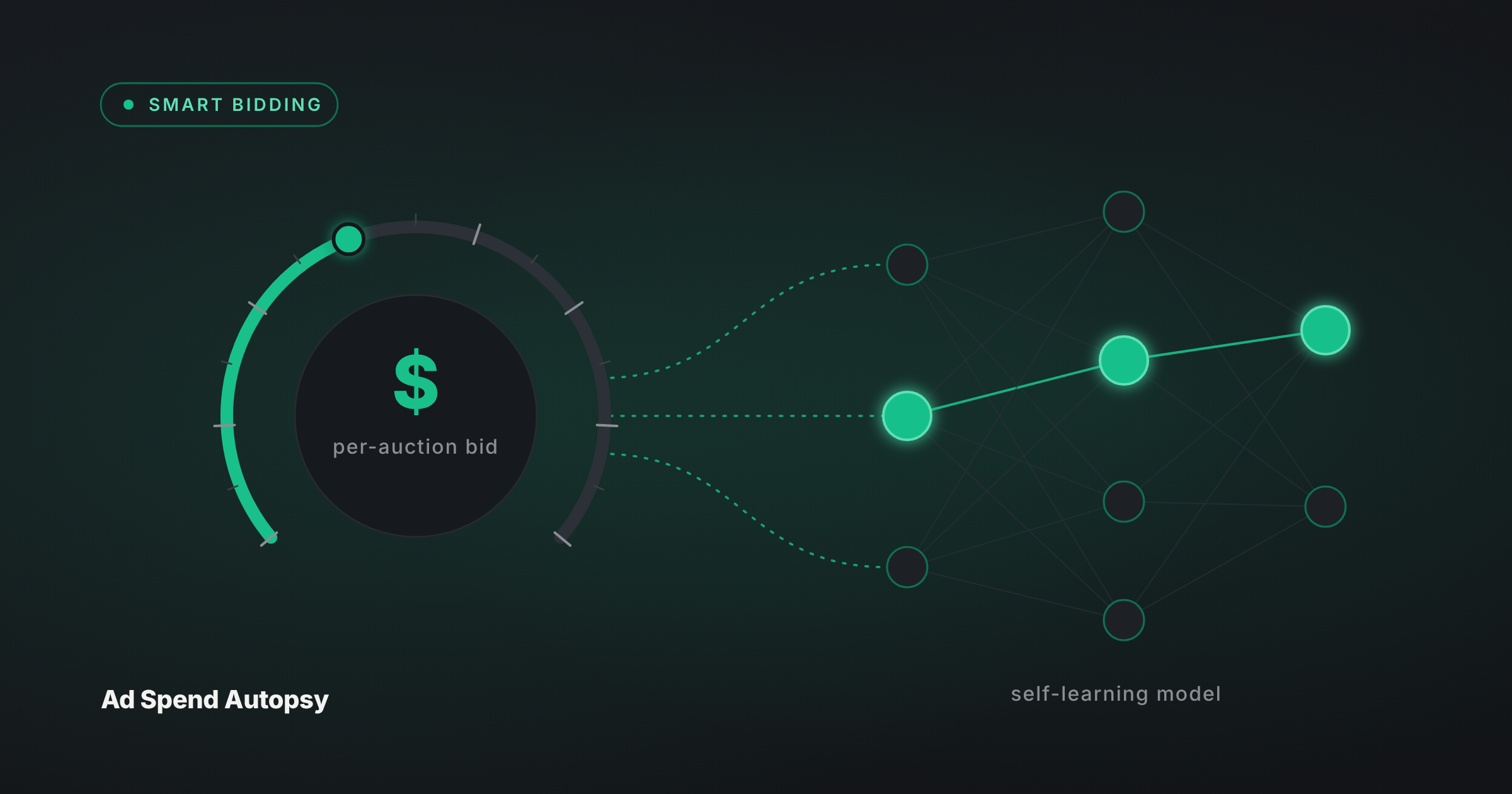
We're all living in the age of AI, and long before it made its way into regular life, it was already dominant in the ad-tech space. Google launched its Smart Bidding strategies to help advertisers get the most value out of their ad spend — a genuinely useful intent.
Except advertisers, to this day, keep struggling to use these strategies effectively. The thing that was supposed to make life easier — for an SMB owner looking after their own Google Ads, or a PPC specialist taking over a client's account — often becomes the thing that quietly burns their money. It's not that the help docs are unclear, and it's not some hidden agenda. Like most things, the illusion fades once you understand what's running under the hood.
So let's do two things. First, unpack what these strategies actually do and how they work functionally (I'm not claiming to know Google's exact math). Then, look at how to actually get the best out of them.
First, pretend automation doesn't exist
Forget, for a moment, that any bidding automation exists — imagine only manual CPC is available. You, the advertiser, set the bids for your keywords, and Google uses those bids to enter you into auctions that are relevant to you.
Traditionally it looks like this:
The manual bidding loop
Set a bid → enter the auction → win a slot → pay on the click → (if tracking is live) record the conversion
You set bids on a set of keywords, you participate in auctions, you win an ad slot, and you pay when someone clicks your ad. Like a smart advertiser, you'd also have set up conversion tracking on your site, so Google knows when a click turns into a real business action — through a conversion tag (the "pixel," in old-school terms, though that word really belongs to the Meta side).
Over the next few days you collect performance data. By the end of the week, you'd notice three kinds of keywords:
The winners
Keywords driving lots of conversions. You'd raise bids here to compete harder for them.
The expensive maybes
Keywords that convert, but not efficiently. You'd hold bids and keep an eye on the cost.
The money pits
Keywords that spent and brought zero conversions. You'd cut bids to stop the bleed.
Repeat that for a month, a quarter, a year, and you'd eventually learn something subtle: for some keywords, a bid above a certain value turns a profitable keyword into a losing one. You develop a feel for each keyword's ceiling.
Now, Smart Bidding automates that entire loop
Smart Bidding turns that whole manual process into a self-learning algorithm. Because it can see patterns across an enormous volume of past auctions and conversions — plus live signals about each specific searcher (device, location, time of day, likely intent, audience) and your Ad Rank — it can estimate a sensible bid for each individual auction.
Here's the difference that matters: manually, you were entering every auction with the same bid value — and that could be millions of auctions over a week. Smart Bidding doesn't make you guess one number for all of them. It sets a different bid for each auction, constantly, based on how likely that specific click is to convert.
| Manual CPC | Smart Bidding | |
|---|---|---|
| Who sets the bid | You, per keyword | Google, per auction |
| How often bids change | When you log in and edit | Every auction, in real time |
| What it reacts to | Your weekly review | Live signals: device, location, time, intent, audience… |
| What it needs from you | Time and attention | Conversion data — and enough of it |
| Where it falls apart | You don't have time to optimise | You don't have enough conversions to learn from |
But bidding automatically isn't the same as bidding profitably
This is where most of the struggle actually lives.
It's one thing to set bids automatically, and another to do it profitably. For the algorithm to predict which clicks are worth more, it needs to see the full chain — impression → click → conversion — happen enough times to find a pattern. And "enough" is the key word.
Any statistical system needs a minimum number of observations before its predictions mean anything. It's the same reason you wouldn't judge a coin as rigged after three flips. Below that threshold, the system isn't learning your account — it's guessing, and the guesses swing wildly. This is the "learning phase" you'll see Google mention, and it's the quiet reason so many smaller accounts feel like Smart Bidding "stopped working" or "never worked."
Is your account ready for Smart Bidding?
Two checks decide whether automation can actually learn
So if your account is small and your conversions are sparse, the honest answer isn't "Smart Bidding is bad." It's "your account isn't feeding it enough yet." The fix is usually unglamorous: make sure tracking is clean, concentrate your budget instead of spreading it thin, run a simpler strategy while you build volume, and only hand the wheel to Smart Bidding once there's enough data for it to drive on.
Used at the right time, with clean data and a clear goal, Smart Bidding genuinely does what it promised. Used too early, on an account that can't feed it, it behaves exactly like the nightmare everyone complains about. Same tool — the difference is whether you gave it enough to learn from.
Not sure your account has the volume — or the tracking — for Smart Bidding?
Run your export through the free Ad Spend Autopsy audit. It flags the exact things that starve automated bidding: zero-conversion spend, broad-match leaks, budget caps and thin conversion volume.
Run the free audit